Urinary Tract Infections in Children and Adolescents
JAMA PEDIATRICS PATIENT PAGE
Urinary Tract Infections in Children and Adolescents
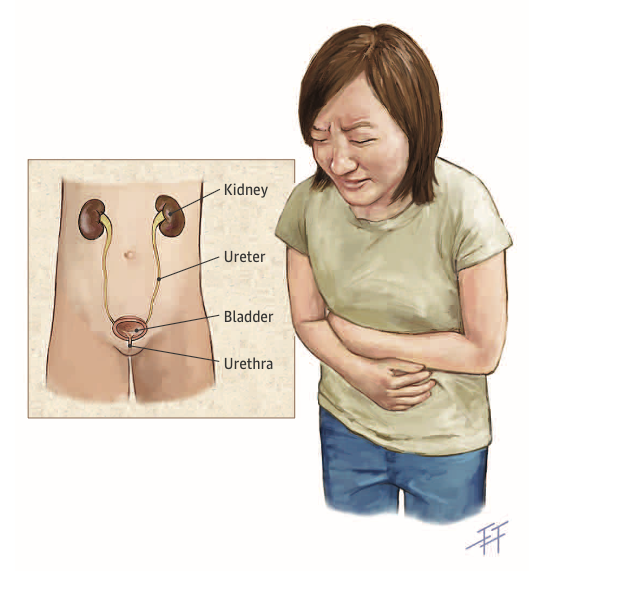
The urinary tract includes several parts of the body, including the kidneys,the bladder, ureters, and the urethra.
The kidneys are 2 bean-shape organs located in the abdominal area that filter blood to clean it and make urine as a byproduct. The urine travels down the ureters to the bladder for storage. The urethra connects the bladder to the outside of the body where urine leaves the body. Any of these parts of the urinary tract can get an infection called a urinary tract infection (UTI). Urinary tract infections are common in infants and young children. About 3% of girls and 1% of boys will have a UTI by 11 years of age. Urinary tract infections are also common in female adolescents and young women; young women develop UTIs at more than 3 times the rate of young men. Symptoms of UTIs may include the following:
- Urine-related symptoms may include burning or pain during urination, needing to urinate more often, difficulty getting urine out,urgently needing to urinate, or having an “accident” such as wetting underwear or the bed by a child who knows how to use the toilet, foul-smelling urine, or cloudy or bloody urine.
- Vomiting, nausea, not wanting to eat.
- Fever and chills.
- Abdominal pain, side pain, or back pain.
Sometimes the symptoms are not obvious to the child or to the parents, such as irritability in an infant or unexplained fever in a small child. A young child with a high fever and no other symptoms has a 1 in 20 chance of having a UTI.
Evaluation for a UTI includes testing a urine sample, called a urinalysis. The urine can also be checked for bacteria, called a urine culture. Urinary tract infections are caused by bacteria that get into the urinary tract by the skin around the genitals and rectum, or by the bloodstream from other parts of the body. In young children and children with repeated UTIs, an ultrasonography examination of the urinary system may be done.
Treatment of a UTI is with antibiotics to eliminate the bacteria.The way your child receives the antibiotics depends on the severity of the infection and which parts of the urinary tract are involved in the infection. An infection that involves the kidneys is more serious because of the concern that the infection could damage the kidneys. It is important to treat the urinary infection quickly to prevent the spread of the infection and reduce the chances of damage to the kidney. This month’s issue of JAMA Pediatrics includes a research study showing that early antibiotic treatment of UTIs helped prevent the risk of damage to the kidneys. This research study shows the importance of quick diagnosis and treatment.
Girls as well as young women are particularly susceptible to UTIs because their urethras are shorter so germs from the bowel can pass alongthisroutetothebladder.TopreventUTIs,girlsshouldalwayswipe from front to back with toilet paper after bowel movements. Adolescent females who are menstruating should change tampons and sanitary napkins frequently. Since bubble baths and perfumed soaps can irritate the genitals and urethra, girls should avoid contact with these substances.Somefoodsandbeveragescancausebladderirritationsuch ascolas,caffeinateddrinks,chocolate,andsomespices.Ifyourchildhas any of the symptoms of a UTI listed above, contact your pediatrician.